VCF SOCAL 2026

Preserve or Power On?
Reflections from the Vintage Computer Festival SoCal
Article and Photographs by Nancy Chen
On February 14 and 15, the Paul Gray PC Museum packed five pieces from our collection and traveled to the Vintage Computer Festival in Anaheim, California, a two-day convention for vintage computer enthusiasts (as the name suggests).
Arrival at VCF
I arrived at the Hotel Fera around 9 a.m., slung my bag across my shoulders, grabbed my camera, and entered the convention hall. The PGPCM has attended the SoCal festival every year since it began, making this its third year there. As it was my first year in attendance, I was entirely unsure what to expect, but I was extremely excited. The hall outside the main exhibitor area was lit by dim yellow light (quite suspenseful for me, at the time). I headed to the registration booth, and after a brief mishap of not being on the list for entry, I was given my badge and lanyard by the very kind volunteers. So… this was it.
A Hall Full of History
My worries were put to rest as soon as I walked in. Rows of tables lined the exhibition hall, with various computers and other vintage devices spread across them: laptops, luggables, large monitors, small monitors, hacks, custom builds, and telephones. The vendor hall was full of all sorts of PCs in very nice condition (and some not so), along with a neat booth selling Apple-related pins and stickers.
The main exhibitor hall had a steady flow of people throughout the day. I had a blast the first day playing games, talking to people, admiring computers, getting beaten at chess by computers, admiring other beautiful creatures (ahem, like telephones), buying things, participating in the AIM group chat set up spanning several different tables, and playing even more games. I was so occupied that I only realized I had forgotten to take photos on the drive back home.
Music, Community, and Culture
The Stop Bits, a band composed of vintage computer enthusiasts, also performed after the end of the first day at 7 PM. I only talked with them briefly and grabbed a sticker during the day, and unfortunately had to leave before the show… They have an album, “Return From Interrupt,” out on Bandcamp (https://thestopbits.bandcamp.com/album/return-from-interrupt), if you’d like to check it out. Their songs are catchy and about things like BASIC and capacitors exploding.
The VCF website offers a comprehensive list of exhibits with descriptions that do a great job of conveying what was on display, but I don’t think they truly capture how fun it was to experience them in person. I’ll describe a few of my favorites.
A Few Favorites
At the very back of the exhibitor hall was a table aptly named “Luggables! by Zachary Calcagno” full of all sorts of luggable computers. Notable was the Kuromi luggable, an un-branded machine, somewhat similar in build to the Osborne, given a Kuromi theme by the exhibitor. (So cute!!!) Several of those luggables were also connected to the internet and could communicate with each other. Another notable table featuring various Apple computers connected through AIM chat, reminiscent of the early 2000s, was also present and titled “PPC.IO by Trekintosh.”

There was an exhibit of vintage and novelty telephones (PBX Demonstration with Vintage Phones by N. Sputnik) relatively close to our table. It was beautiful to witness. One telephone looked like those old porcelain tea sets with flowers on them. Another was neon green, its base in the shape of a triangle. Yet another had a totally transparent shell, all its insides visible. They were also all connected to a custom phone network which played a variety of recordings based on three-number extensions you could dial. I messed around a bit with the dial-a-TMBG (They Might Be Giants), trying random numbers hoping I would land on “Birdhouse In Your Soul.”
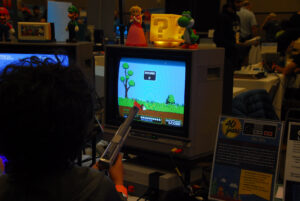
One of the exhibits towards the right (Levi’s Digital Voyage by Levi Maaia) had, I think, two Apple computers running some 8-bit Nintendo games. I found much joy playing Duck Hunt for the very first time in my life, getting a score of something around 200000? I was quite proud of myself for that. I had a chat with someone playing Tetris, giving me tips as I fumbled through a few games for the first time.
Paul Gray PC Museum and Computer Museum of America
Right next to us was the Computer Museum of America, which shut down in 2005 and is now housed in storage at San Diego State University. In collaboration with SDSU, The Paul Gray PC Museum and CGU grad students are currently working to catalogue their collection. Their table had several computers and a few other objects, like a bag of signal flags symbolizing early encoding systems and business cards printed on old punch cards. We are currently accepting donations to support the process.
Donate to Paul Gray PC Museum Here
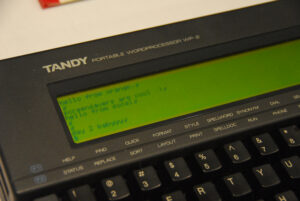
Our table was simple but solid, showcasing a few computers using the Zilog 80 chip (those being the Otrona Attache, the Osborne I, the TRS-80, and the WP-2). Unlike much of the convention, we only had one operating machine, the WP-2.
The Preservation Paradox
A majority of our catalog (contained entirely within one small storage space at the back of a classroom) is non-operational or untested, and all of our computers on exhibition are permanently unpowered. Our Otrona Attache, for example, has never been turned on; we have found minor corrosion and leakage on its power board, and in the interest of keeping it un-exploded, it waits in a queue for restoration.
What many attendees at VCF might have considered excess, this effort to exercise caution stems from our position as a museum rather than as hobbyists. We want to preserve things so that they can be shared with as much of their original value and historical integrity as possible.
As a museum, our priority is preservation. As a computer museum, we face a bit of a conundrum. To operate a computer is to speed up its eventual decay, something essentially antithetical to the idea of preservation, yet the operation of a computer is part of its value as a cultural object. The PGPCM’s mission is to both preserve its collection for research and to study the ways computers have intersected with everyday human life.
I think computers differ from many other historical objects (chairs, paintings, sewing machines) in that they have a much greater amount of value in their operation – that what’s on them, or having them running, makes up just as much as their value as their physical shell. (Emulation, however, can absolutely play a part in doing the same thing.) Baz and I discussed this as I wrote the post; he offered the perspective that this view is possibly due to the fact that computers are still so new. Because this lineage of objects has remained in-use every day, we still don’t fully view them as historical objects.
What’s the best answer to this problem? Is there one? The Computer History Museum, for example, only considers restoration if there is a second instance of a historically significant system.1 Parts constantly degrade when in use; any museum attempting to keep a living exhibition operating will have to face the problem of replacing those parts when they break. If the operating artifact is historic, those necessary parts are likely no longer in production and must be salvaged from other objects—ones considered disposable enough to be used for parts. Some computers are determined to hold more value than others, whether that be by virtue of rarity, condition, or another aspect.
The Value of Vintage Computing
This presents a question at the center of the vintage computing community. What is the value of vintage computers? Why would anyone at all care about these impractical hunks of metal and plastic, that on top of needing possibly hundreds of dollars to acquire and maintain, can only do a fraction of what a modern laptop could?
The museum perspective has already been discussed. These are historical objects with cultural significance that can give precious information about the era they were from, the people in that era, and countless other things – this precious information can help us better understand our present context and culture. But what about a more personal perspective?
Nostalgia for A Time Never Lived
The blurb on the VCF website for PBX Demonstration with Vintage Phones ends with an interesting statement. “For some, a return to the weight and click of analog telephones; for others, nostalgia for a time they never experienced.”
Many of the people at the festival were older adults—people who had grown up with some or all the technology there. People passing by our exhibition would fondly note how the TRS-80 (“trash-80”) was their first computer or inform their partner of some fun history tidbit about the Osborne. Besides kids with their parents, I also ran into some younger folks who probably just showed up for the ending.
I’m certain most of the tech there is older than I am. For me, one of the biggest reasons I like vintage computers is just how they look and feel. They’re just cool, man. The diversity in their builds, and the evolution of that over time—the specific aesthetic of the iMac G3’s desktop and those awesome telephones.
I think there’s also significant overlap with the institutional view, that the cultural and historical significance of a computer also might make up a huge part of their value to a person. Certain computers are considered rare and thus worthy of a higher price – some of these were being sold in the consignment and vendor halls. And at the end of the day, it’s undeniable that all this is being influenced by some degree of nostalgia. Different degrees for different things and different people.
For some, they may think computers are beautiful or cool. For some, they are more interested in the historical. Maybe it’s because they enjoy the act of collecting or they are a curator for some institution. It is possible some think games just look better on a CRT. I’d love to hear why you would or did attend or any other thoughts! I had fun meeting all the folks at VCF; I really do think it had something for everyone.
Share