IDOR Case Study: The Preventable Data Breach That Exposed 64 Million McDonald’s Job Applications in Summer 2025

A Simple Breach With Major Consequences
In June 2025, security researchers Ian Carroll and Sam Curry identified a cybersecurity nightmare that should serve as a wake-up call for every organization. The McDonald’s hiring system, built by Paradox.ai, leaked the personal information of 64 million job applicants due to due to fundamental security vulnerabilities in their AI-powered hiring system.
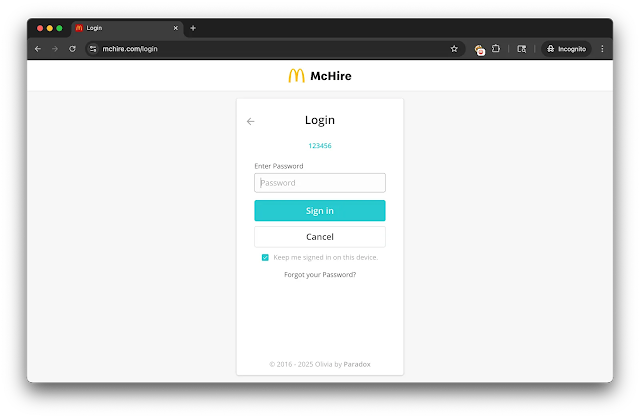
The most stunning part? The entire system was compromised using the password “123456” from a test account that had been abandoned since 2019.
What Happened: A 30-Minute Hack
The McHire platform uses an AI chatbot named “Olivia” to screen job applicants at McDonald’s franchise locations across the country. What should have been a secure, automated hiring process became a data protection disaster when researchers discovered:
• Weak Authentication: A Paradox.ai administrator account was secured with the username and password “123456”
• No Multi-Factor Authentication: The compromised account lacked basic 2FA protection
• Insecure Direct Object Reference (IDOR): By manipulating applicant ID numbers, hackers could access any applicant’s personal data
• Account Lifecycle Management Failure: The vulnerable test account had been dormant since 2019 but was never decommissioned
The exposed data included names, email addresses, phone numbers, and complete chat histories between applicants and the AI system, creating a goldmine for phishing attacks and employment fraud.

Why This Matters for Today’s Businesses
Paradox.ai has positioned Olivia as a sophisticated AI recruitment tool designed to streamline candidate screening, interview scheduling, and applicant communication through text-based interactions. The company promotes the system as both an efficiency booster and a user-friendly interface that creates positive experiences for job seekers throughout the application process.
For high-volume employers like McDonald’s, which processes applications from thousands of hourly workers, Olivia manages substantial portions of the recruitment workflow. Many candidates complete their entire application journey without human contact until reaching final hiring decisions.
This automation trend extends far beyond McDonald’s operations. According to NYT reporting, major corporations increasingly deploy AI systems for preliminary candidate interviews and automated applicant filtering. The recruitment technology landscape now features comprehensive AI-powered platforms that handle everything from candidate-job matching algorithms to résumé analysis and scheduling automation. Yet as Carroll and Curry’s investigation revealed, these efficiency gains introduce significant data security vulnerabilities.

Technical Vulnerabilities Exposed
• Password Security: The “123456” password represents a fundamental failure in security hygiene. This breach demonstrates why password policies and complexity requirements exist.
• IDOR Vulnerabilities: The ability to manipulate applicant IDs to access other records in this application design highlights the preventable nature of this data breach. Verify the user’s permission every time an access attempt is made. Implement this feature by design; proper access controls should validate user permissions before returning data.
• Authentication Bypass: The lack of multi-factor authentication on administrator accounts created a single point of failure that compromised the entire system.
• Account Lifecycle Management: The five-year gap between account creation and discovery demonstrates the critical need for systematic account auditing and decommissioning processes.
Business Impact Analysis
• Reputational Damage: Both McDonald’s and Paradox.ai faced public scrutiny and potential customer trust issues.
• Legal Liability: With 64 million potentially affected individuals, the legal and regulatory consequences could be substantial.
• Operational Disruption: The companies had to implement emergency fixes and launch new security programs to address the vulnerabilities.
What Organizations Can Do Now
Immediate Actions
 Audit All Accounts: Inventory every account in every system, including test and development environments
Implement Account Lifecycle Policies: Establish mandatory decommissioning procedures for temporary accounts
Enable MFA Everywhere: No exceptions for administrative or service accounts
Password Policy Enforcement: Establish and enforce strong password requirements across all environments
Long-Term Security Hygiene
Automated Account Monitoring: Deploy tools that flag dormant accounts for review
Regular Access Reviews: Quarterly audits of all privileged access, including forgotten accounts
Documentation Standards: Maintain comprehensive records of all system access points
Vendor Security Assessment: Include account management practices in third-party security evaluations
A Silver Lining: Responsible Disclosure
Carroll and Curry demonstrated ethical hacking by:
Limiting their access to only seven records during testing
Immediately reporting the vulnerability to both companies
Working with the organizations to ensure rapid remediation
Publishing findings only after fixes were implemented
Both McDonald’s and Paradox.ai responded quickly, fixing the vulnerabilities within 24 hours and launching a bug bounty program to identify future security issues.
Bottom Line for Today’s Business Leaders
This breach serves as a stark reminder that cybersecurity is not a mere “IT problem”, but a business risk that requires executive attention and investment. As organizations across the globe continue to adopt AI and automation technologies, they must ensure these innovations don’t compromise the security and privacy of their customers and employees.
The McDonald’s breach proves that even simple security failures can have massive consequences. Don’t let your organization become the next cautionary tale.
Any opinions, findings, and conclusions or recommendations expressed in this material are those of the author and do not necessarily reflect the views of the National Science Foundation.
For 7Cs students interested in cybersecurity careers, this case study demonstrates the critical importance of security fundamentals, ethical hacking practices, and the intersection of technology and business risk management. Consider exploring our coursework in penetration testing, security architecture, and risk management to prepare for this rapidly growing field. →
Share